Tuesday, August 11, 2026


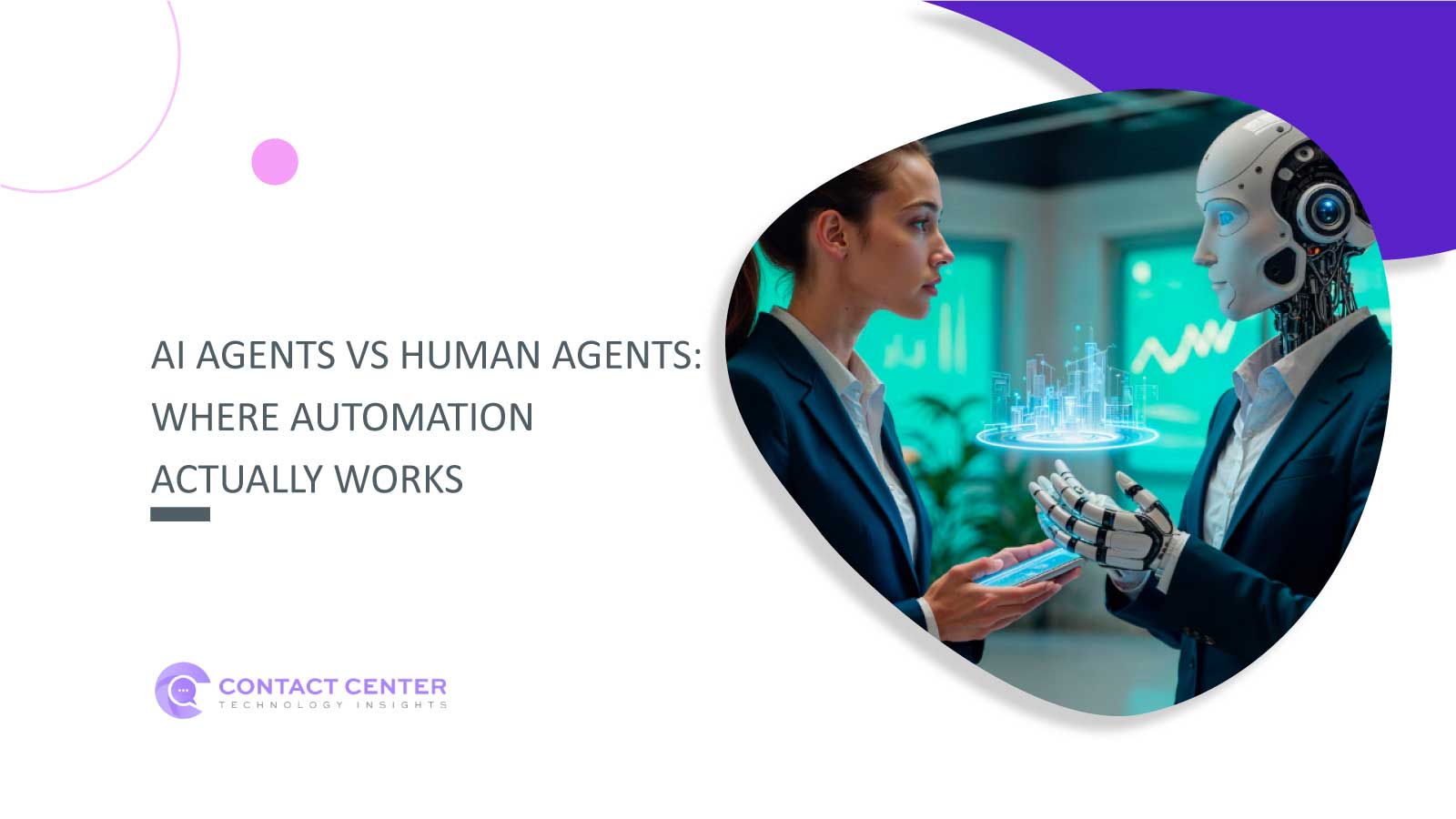
The contact center has quietly become the most honest proving ground for enterprise AI and, increasingly, for AI agents themselves. Not the lab. Not the keynote demo. The queue. Customers do not care about model architecture or “agentic workflows.” They care whether someone, human or AI agent, fixes the problem in three minutes or traps them in a bot loop for twelve.
So the debate is not philosophical. It is operational. Where does automation genuinely create value, and where does it quietly erode trust? What follows is less theory and more pattern recognition from what is actually working on the floor.
Across industries, most inbound volume is repetitive. Password resets. Shipping updates. Billing copies. McKinsey notes that many customer requests follow predictable workflows that can be digitized or automated using existing technologies. The implication is not full autonomy, but selective automation. A substantial portion of contact volume, particularly transactional inquiries, can be resolved without human intervention when workflows are clearly defined and decision paths are structured.
This is exactly where AI agents perform well.
Intent classification. Knowledge retrieval. Workflow routing. Structured inputs with narrow solution paths. Modern conversational systems, when trained on domain data instead of generic corpora, regularly achieve intent recognition accuracy in the high 80s or low 90s. The result is practical, not glamorous. Shorter queues. Lower cost per contact. Less agent burnout.
Here is where executive teams get into trouble. They assume success in the first 60 percent can scale to 90 percent. It cannot.
The remaining interactions are not simply harder versions of the same problem. They are qualitatively different. These conversations require judgment, negotiation, and sometimes empathy. Not pattern matching.
Gartner’s recent customer experience research shows the split clearly. Most consumers are fine with automation for simple tasks, but roughly two-thirds prefer a human for complex or emotionally sensitive issues. Push them through bots anyway, and satisfaction drops fast.
There is also a security angle that CISOs cannot ignore. AI systems process enormous volumes of conversational data and PII. Without strict controls, models may retain or expose sensitive information. So the AI agent suddenly requires redaction layers, audit trails, and oversight teams. Necessary. Expensive. The savings story gets complicated.
This is the trade-off leaders feel in the budget review but rarely see acknowledged in vendor decks.
The organizations quietly succeeding are not chasing full replacement. They are designing orchestration.
AI handles triage first. Classify the issue. Pull context. Resolve the easy cases automatically. Then escalate anything ambiguous or high risk to a human, with the history and recommended next steps already prepared.
The agent does not start from scratch. They start informed.
Real-world evidence from industry analysts shows that automation isn’t a binary choice between bots and humans. Forrester’s research on customer service automation illustrates a persistent pattern: when AI agents handle predictable tasks and seamlessly defer to human expertise on ambiguity or emotion, key performance outcomes improve across the board.
This trend isn’t about cutting headcount. It’s about optimizing where automation is applied. Organizations that adopt this hybrid model consistently see not only reductions in average handle time and operating costs but also gains in first-contact resolution and customer satisfaction.
Those gains materialize because customers escape the frustration of dead-end automation loops, and human agents engage with the right context already in hand.
• Automation shines at pattern recognition and transactional tasks, but those alone don’t build loyalty.
• A hybrid design treats AI agents as triage engines and human agents as problem solvers.
• This alignment improves the customer experience without undoing cost discipline.
This changes the role of the human agent. Fewer switchboard operators. More specialists. More judgment. Fewer repetitive tasks.
For CMOs, that protects brand experience. For CISOs, it limits where sensitive decisions occur. For finance leaders, it captures efficiency without betting everything on brittle autonomy.
It is not elegant. It is practical.
This is not a workforce debate. It is a boundary decision.
The executive question is not whether AI agents replace people. It is where autonomy stops.
Automate aggressively where outcomes are predictable and reversible. Status checks. FAQs. Balance inquiries. Straight-through transactions with clear guardrails. These are commodities. Treat them that way. If an AI agent fails, the damage is minor and easily corrected.
Anything involving money movement, regulatory exposure, or reputational risk. That is where human judgment still outperforms machine probability, and likely will for the foreseeable future.
The contact center does not hide weaknesses. It amplifies them. Edge cases surface daily. Policies shift. Customers react emotionally. Models hallucinate under ambiguity. Humans improvise under pressure.
So the pragmatic strategy is disciplined orchestration. Let machines absorb the pattern density. Let people manage the ambiguity.
Anything beyond that, full replacement rhetoric or blind resistance to automation, is performance art. Customers will detect the disconnect long before your dashboards do.
Empower your contact center team with actionable insights that drive measurable results.
Qualtrics brings intent tech to contact centers, turning interaction data into faster decisions, better service, and measurable ROI.
AI is reshaping contact centers. See how NVIDIA, AMD, Intel, and emerging accelerators determine real-time performance, latency, and customer experience outcomes.