Sunday, August 09, 2026


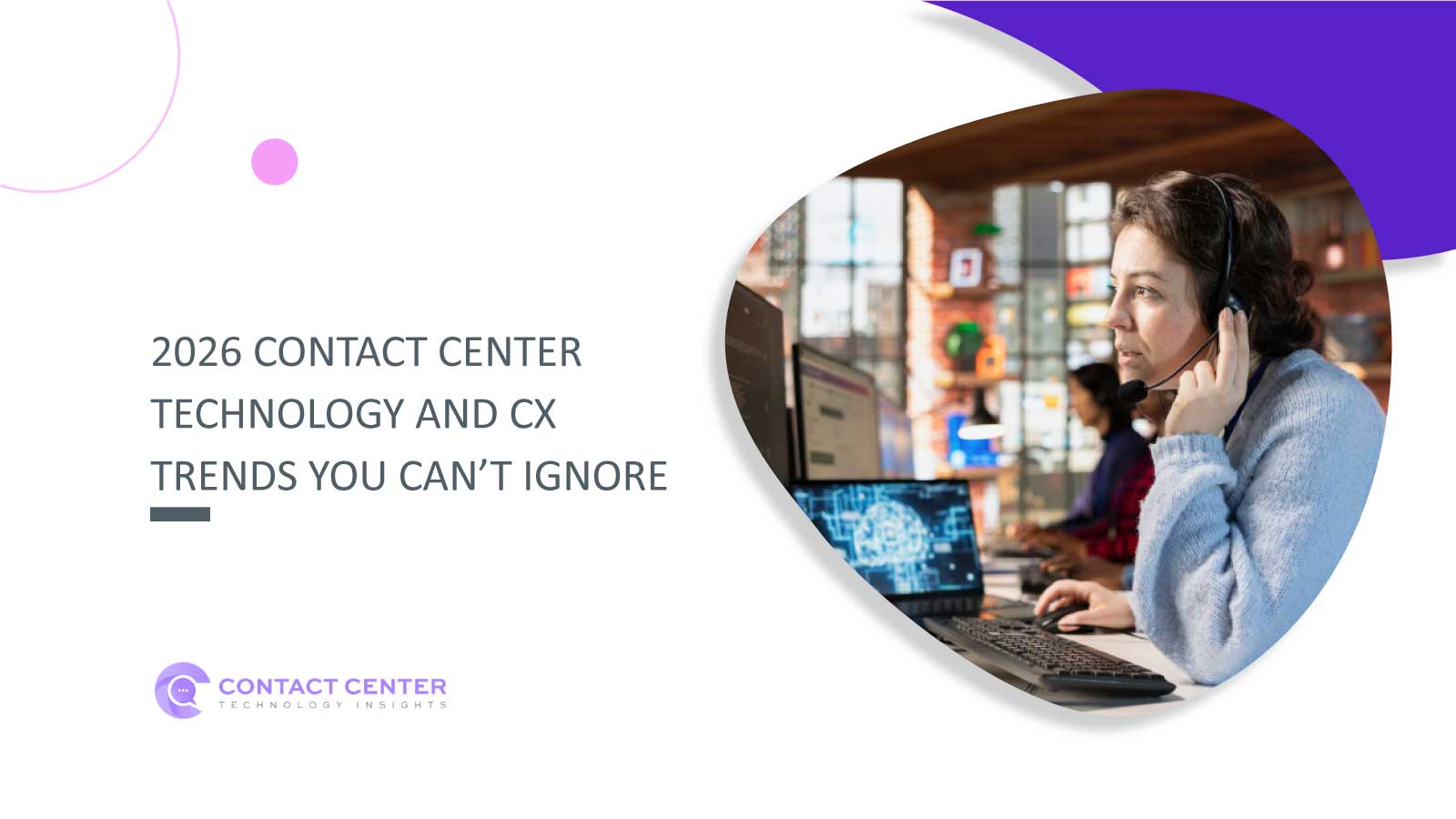
Contact centers in 2026 are judged by how intelligently they resolve problems, how safely they deploy AI, and how consistently they deliver experience across channels that were never designed to work together.
The mandate is clear. Reduce cost volatility without eroding trust. Modernize aggressively without breaking compliance. And make AI useful, not performative.
This article explores the contact center technology and CX trends that are already shaping budgets, vendor roadmaps, and operating models going into 2026.
The era of bolt-on chatbots is fading. In its place, enterprises are investing in AI orchestration layers that coordinate intent detection, knowledge retrieval, agent assist, QA, and post-interaction analytics as a single system.
While AI has been sold as a cost lever, Gartner warns that operational costs for generative AI workflows in contact centers could surpass the price of offshore human labor by the end of the decade, refocusing investment decisions on where AI adds clear value versus where human intervention remains more efficient.
“Customer service leaders are determined to use AI to reduce costs, but return on those investments is far from guaranteed,” said Patrick Quinlan, Senior Director Analyst in the Gartner Customer Service and Support practice. “Full automation will be prohibitively expensive for most organizations; instead, leading organizations will use AI to drive customer engagement rather than to cut costs.”
The practical shift is this. AI is no longer evaluated by deflection rates alone. It is judged by how well it supports agents mid-conversation, how cleanly it hands off context, and how auditable its decisions are. Contact center leaders who still treat conversational AI as a front-door experiment are already behind.
For years, agent experience was discussed as a soft HR concern. In 2026, it is a first-order CX variable.
According to NICE’s 2025 CX Workforce Report, agent turnover in complex service environments remains above 30 percent annually, with tool sprawl and cognitive overload cited as leading contributors. At the same time, Forrester’s 2024 US CX Index analysis showed a direct correlation between agent enablement maturity and customer satisfaction stability during demand spikes.

This is driving renewed investment in real-time agent assist, unified desktops, and workflow automation that removes after-call work rather than adding guidance layers. The trade-off is obvious. These systems require deep CRM, WFM, and knowledge integration. Half-implemented agent assist creates more friction than value.
Despite years of “voice is dead” narratives, voice remains the dominant channel for high-stakes, high-emotion interactions. What is changing is how voice is processed and analyzed.
Real-time speech-to-text, sentiment analysis, and compliance monitoring are now table stakes. What is emerging in 2026 is post-interaction intelligence that feeds product, policy, and risk teams, not just QA dashboards.
The constraint is data governance. Voice data is among the most regulated and sensitive datasets enterprises hold. Expect continued friction between CX ambition and legal reality.
Everyone wants proactive service. Few can afford to do it poorly. In 2026, proactive outreach is increasingly constrained by consent management, data freshness, and predictive accuracy.
In the push to make experiences proactive, many contact center leaders overlook the customer’s tolerance for relevance and timing. Steve Sellin, CX Strategist & Solutions Advisor at Upwork, captures this tension succinctly. Drawing on McKinsey-linked research and his operational experience, he highlights that accurate proactive status updates can cut inbound volume by roughly 20–30 percent, but only when those alerts are genuinely meaningful to the customer*. When notifications are poorly targeted or poorly timed, they create confusion, erode trust, and can drive more inbound traffic — the opposite of the intended efficiency gain.
This is a quiet shift away from “always-on engagement” toward precision intervention. It is less exciting. It works better.
Every vendor promises a unified customer view. Few deliver one that survives real-world complexity.
By 2026, most enterprises accept that perfect unification is unrealistic. The focus is shifting to situational context assembly. Pulling the right data at the right moment, rather than everything all the time.
Salesforce’s 2024 Trends in Customer Trust report highlighted growing customer sensitivity to data over-collection. That pressure is forcing CX architects to design for minimal sufficiency instead of maximal visibility. It is a philosophical shift with technical consequences, especially for legacy-heavy environments.
Contact centers are now a primary attack surface for social engineering and data leakage. Add generative AI to the mix and risk multiplies.
Zscaler’s 2025 ThreatLabz research showed a sharp increase in AI-enabled phishing and impersonation attempts routed through customer service channels. As a result, security tooling is moving closer to CX platforms. Real-time authentication, AI usage logging, and policy enforcement are no longer optional add-ons.
The tension here is speed versus control. Over-securing CX workflows degrades experience. Under-securing them invites regulatory and reputational damage. There is no clean answer. Only trade-offs.
Artificial intelligence is reshaping the contact center, but real customer experience gains come from contextual intelligence, intent recognition, and human-led AI.
Qualtrics brings intent tech to contact centers, turning interaction data into faster decisions, better service, and measurable ROI.