Tuesday, July 28, 2026


Welcome to the Contact Center Technology Top Voice Interview Series, where we spotlight leaders shaping the future of customer experience, AI-driven contact centers, and enterprise support automation.
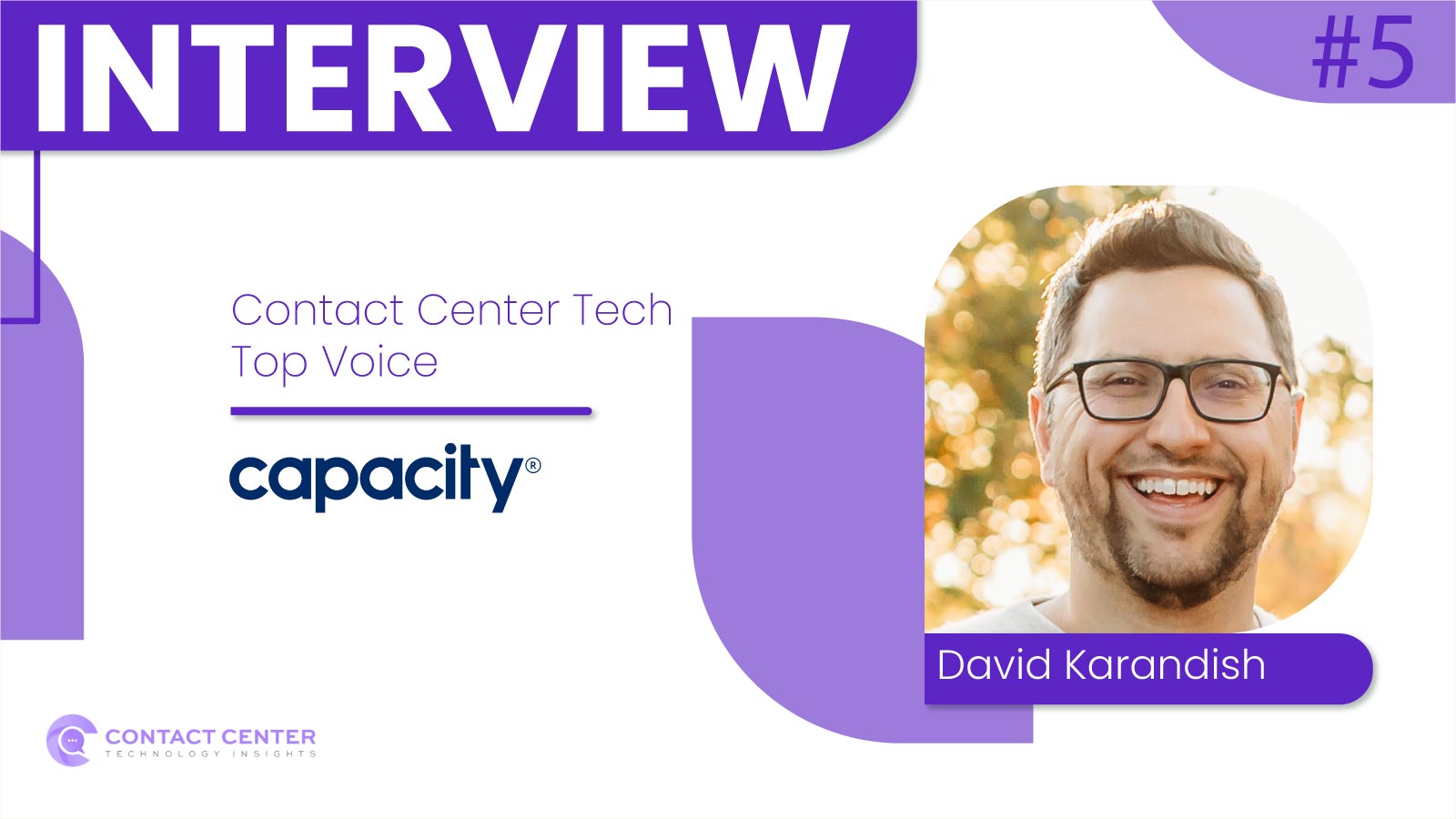
For this edition, Sudipto Ghosh, Head of Global Marketing at Intent Amplify, interviewed David Karandish, Founder & CEO of Capacity—a pioneer in applying practical and generative AI to eliminate friction across customer and employee support.
David brings over 25 years of experience building technology companies that help teams do their best work. He founded Capacity in 2017 after recognizing an inflection point in conversational AI and its potential to automate repetitive work while preserving what humans do best. Under his leadership, Capacity has evolved into an integrated, AI-powered omnichannel support platform—spanning voice, chat, SMS, email, workflow automation, and help desks—used by more than 20,000 organizations worldwide. Through a deliberate compound growth strategy and strategic acquisitions, David has positioned Capacity at the center of modern contact center transformation, with a strong focus on intelligent escalation, context preservation, and customer confidence.
In this conversation, David shares sharp insights on why traditional support metrics fall short, how “closure” differs from resolution, and what AI-human orchestration must look like as we move toward 2026 especially in high-stakes environments like healthcare.
David, thank you for joining us on the Contact Center Technology Top Voice program.
David : I’ve been in tech and AI for about 25 years, building companies that help teams do their best work.
In late 2016, the idea for Capacity came from a simple observation: Once consumers adopt new technology, businesses quickly follow suit. That Christmas, Amazon's Alexa became the world’s top-selling consumer product. The technology wasn’t perfect, but consumers were adopting it. It was clear to me that conversational AI was reaching an inflection point with real implications for the workplace.
I founded Capacity in January 2017, believing this technology could reduce repetitive tasks and friction across organizations. Initially, we automated internal support for the departments where repetition was most visible: HR, IT and Legal. Once clients saw the impact internally, they wanted the same experience for their customers, which brought us into contact centers.
We then noticed a problem within customer support, specifically. Organizations were using too many disconnected tools, creating a fragmented experience for the customer and a headache for the team. We set out to build an integrated, AI-powered omnichannel support automation platform to solve this. Using a compound startup strategy, we grew Capacity through intentional acquisitions to bring together helpdesk, voice, chat, SMS and workflow capabilities under one roof. All along, our mission to automate repetitive tasks so teams can do their best work has remained the same.
Recommended: Contact Center Tech Top Voice: Interview with Jamie Cooper, Chief Product Officer at Natterbox
David : Most support metrics measure how fast a ticket gets closed, not whether the customer left feeling confident or reassured. Resolution may be a helpful internal metric, but closure is a more accurate emotional metric for customers. That’s the distinction companies are missing.
Our team at Capacity surveyed 1,000 U.S. customers and found that only 42% felt their issue was fully resolved after an interaction. The other 58% leave with lingering doubts or partial resolution. Even more telling, while 33% told us they felt relief at the end of a support interaction, only 17% actually felt confident in the brand. Even when the immediate problem is over, it doesn’t mean the customer trusts the brand or believes it won’t happen again.
Ultimately, call centers are optimizing for the wrong outcome. Metrics like CSAT, FCR and ticket closure give an incomplete picture of the experience. What also needs to be measured is whether a customer feels reassured or understands the next steps. That’s closure, and it’s what drives trust and retention.
and human support, but more so about orchestrating the two based on what the customer actually needs in the moment.
AI can also support closure after the interaction ends. By automating follow-ups and closing loops, we eliminate customer uncertainty and kill churn before it starts.
Ultimately, Capacity helps bridge the gap between a quick answer and a full resolution, orchestrating automated omnichannel support with seamless human escalation. That's where real business impact shows up. With the right balance between AI and human support, Capacity helps brands retain customers, protect revenue and grow.
David : Our philosophy at Capacity is that AI should handle what AI does best, and humans should handle what humans do best. That may sound simple, but many companies are still trying to force one or the other to handle everything.
AI is great at delivering fast, always-on support across voice, chat, SMS, email and web. It can offer customers speed and accuracy, though not necessarily empathy or judgment. That’s why escalation matters. We had 85% of customers tell us that a smooth escalation from AI to a human is important. When an issue turns complex or requires emotional support, human agents need to step in. It’s not about choosing between AI
David : AI support can help answer customer questions, but it can’t always complete the experience. The Closure Index found that 37% of customers say their issue is mostly resolved but not fully. Another 13% told us they’re issues are only partially resolved. In these cases, the customer may get a fast response, yet they’re left wondering whether their issue was actually handled and if they need to follow up. Those lingering concerns can ultimately harm the customer relationship.
Often, poorly designed escalation paths are the problem. When the AI-to-human handoff fails, customers remain stuck in a loop with AI. In these moments, the technology fails to recognize its limits. In our study, AI scored lowest in delivering closure for this particular reason.
A seamless escalation path is just as important as the quality of your AI tools. When AI reaches its limit, a human agent must be able to seamlessly step in to achieve true closure.
David : Healthcare is a different challenge. The stakes are higher, and the interactions are more emotional. At the same time, patients still need answers to basic questions and immediate, 24/7 support, which puts pressure on frontline teams. That kind of operational tension has pushed us to evolve how our platform handles escalation and context.
Working with clients like Sono Bello, we learned that AI can actually reduce stigma and friction around sensitive topics. People are sometimes more comfortable asking an AI chatbot or a virtual assistant about sensitive or embarrassing topics. But we also saw that AI-only models break down the moment someone needs reassurance or guidance in making a decision.
It was essential that we get that handoff moment between AI and humans right. We wanted to build escalation as a core feature, so our platform prioritizes passing the full context to a human at the moment of handoff. This ensures that the patient’s history, their questions, what had already been attempted by the AI support — all carry through the escalation path to make the experience as seamless as possible.
Recommended: Contact Center Tech Top Voice: Interview with Michelle Schroeder, CMO at PolyAI
David : In 2026, orchestrating the partnership and handoff between AI and human support will be more important than automation alone.
It’s the companies that get escalation right in 2026 who will win and retain more customers. If the customer has to repeat themselves, it sends a clear signal that the system wasn’t paying attention. That’s where trust breaks down. Instead of leaving confident, the customer leaves frustrated.
When the handoff is clean and a human picks up exactly where the AI left off, the experience feels effortless. That only happens when context, intent, sentiment and customer history carry through the entire interaction.
David : CRM platforms capture history, not customer confidence. While traditional CRM and support metrics can tell you what happened to a customer, they won’t give you a full picture of whether or not the customer feels reassured.
The same goes for support automation platforms and analytics tools. Though follow-up surveys can surface sentiment, they’re just a snapshot. They don’t capture whether confidence was maintained across channels, escalations and handoffs. For this reason, closure can’t be captured by a single system or a single data point.
To operationalize closure, tools need to talk to each other so the customer never feels like they’re starting over. It takes intentional integration of existing tools, not adding new ones, to create a seamless customer experience. Closure can happen when there’s better knowledge sharing, ensuring Tier-1 AI support gets accurate context and passes along the full story to human support when necessary.
Recommended: Contact Center Tech Top Voice: Interview with Davit Baghdasaryan, Co-Founder and CEO of Krisp
David : Every support interaction tells you something about what a customer wants and whether they’re likely to stick around. The problem is that most GTM and revenue teams treat support as a cost center, so the goal becomes speed and efficiency. Teams end up focusing more on closing tickets and miss the warning signs of churn sitting right in front of them. Customers who need reassurance leave with only a partial resolution. Those are the customers most at risk of abandoning the brand.
It will be critical to analyze post-support data to understand whether customers experience closure. This data needs to flow directly into intent scoring, lifecycle marketing and retention workflows. Poor closure leads to growth leakage that never shows up in pipeline reports. And because support isn’t operationalized within the revenue engine, customers churn, and teams fail to properly address the problem. Closure has to be treated the same as other customer satisfaction metrics, like CSAT, triggering action when it drops to prevent churn before losing renewals.
Tim Harpe Director, Global Customer Operations at DSW
Thank you so much, David, for answering all our questions! We look forward to having you again at the ContactCenter Technology Top Voice program.
David Bio: David Karandish is Founder & CEO of Capacity – an enterprise SaaS company headquartered in St. Louis, MO. Capacity is a support automation platform that uses AI to deflect emails, calls, and tickets so internal and external support teams can spend more time doing their best work. Prior to starting Capacity, David was the CEO of Answers Corp. He and his business partner Chris Sims started the parent company of Answers in 2006 and sold it to a private equity firm in 2014 for $960m. David sits on the boards of Create a Loop (a computer science education non-profit tackling the digital divide by teaching kids to code). David was also an early investor and board member at Nerdy , an on-demand, real-time learning platform in the ed tech space.
About Capacity:

Founded in 2017, Capacity is an all-in-one, AI-powered support automation platform that uses practical and generative AI to deflect tickets, emails and phone calls—so your team can do their best work. More than 20,000 companies across industries use Capacity for external customer support and internal employee enablement. Today, Capacity offers support over web, SMS, email, voice, social, Slack, MS Teams, help desks and more.
Tags: